In Zambia, the kitchen is outside. Usually I burn wood in my insaka, or cooking shelter, the rotund building in the back of the video. But if I were to burn charcoal, the essential fuel of Zambia, this is how it is done. Steven is demonstrating how to light and sustain a fire, Bwalya is adding the teapot, and the rest of the kids are enjoying tea and candolo, sweet potatos, on my porch.
June 29, 2011
How to light a brasier
In Zambia, the kitchen is outside. Usually I burn wood in my insaka, or cooking shelter, the rotund building in the back of the video. But if I were to burn charcoal, the essential fuel of Zambia, this is how it is done. Steven is demonstrating how to light and sustain a fire, Bwalya is adding the teapot, and the rest of the kids are enjoying tea and candolo, sweet potatos, on my porch.

June 26, 2011
A portrait, briefly, of the school
As much as any description is layered, to degrees of thickness, with one's perceptions and values, I offer this portrait of the Zambian school, colored by the paints of my own thoughts and preconceptions.
The walls are often bare; the blackboard more often than not is painted in the front of the class, with black drips permanently splashed on the space between the board and the floor, as if the wall is melting in the heat of the dry season. The desks, normally arranged to face the front, are divided into groups to adhere to standards of a new curriculum development by an NGO. In fact, the school building itself, too nice in comparison to others, is the product of funding from JICA, a Japanese Peace Corps-esque aid organization. Posters sourced from Scandinavian NGOs and textbooks sponsored by USAID are constant reminders of the interconnectedness, what others would term dependence, of the developing African public school system. I am the only human sign of this foreign aid, other reforms have been already carried out or dropped from above: their authors having spent a few moments on the ground before returning to their countries, or sending funds and paperwork from abroad, satellite technicians of development.
The chalk powdered footprints of pupils lead outside, where they disappear where the concrete gives way quickly to dirt. The campus of the school and its gardens are neat, and pupils can be seen sweeping with bundles of branches and slashing grass with moderately sharpened curved metal rods. The classroom block which stands out from the others was one of the original buildings left after the new blocks were completed two years ago. Its ceiling beams are logs, rather than metal, the doorways are not encumbered by doors. Its middle classroom has holes in the floor large enough to swallow pencils and notebooks; the only room with a door, but no lock, is an office, also unused. The classes which are used have glassless windows which frame the bustle of women and children fetching watcher from a nearby bore hole. The walls are scrawled with incorrectly spelled messages in English advocating the smoking of weed and mourning the loss of dead friends and former lovers. The desks are a physical phenomenon in themselves. Often missing essential components such as nuts and bolts to hold them together, they can be precarious to sit on, and fall apart when moved. When functioning, they often hold more than their shape would allow; in fact, the presence of a visitor such as myself in an already overfull classroom sends ripples which moves students to four or five per desk, adolescent legs splayed as shoulders tightly touch. The edges of the desks, particle board with a slight bevel, wear significant signs of wear as they are moved from classrooms by the students themselves, shifting around to accommodate for fluctuating attendance.
The Head Teacher's office, immaculate, with piles of reports and letters stamped into officiality with the proper Ministry of Education stamps and signatures. And endless progression of parents, pupils, and community members come through, requesting transfers to and from other schools, bringing school purchased brooms and produce, and getting documentation of school fees paid for by NGOs. The library, so-called, is a locked cabinet with books cared for since their deployment, since it is not known when more will arrive.
The trees in front of the school are tall, some of them fir trees despite the climate, and I search for a metaphor to relate them to. If the Bemba proverb is true, and young trees make the forest, what happens if they aren't taken care of, or are overrun by weeds?
The pupils, with their pencils as nubs so small they look as if they are writing with nothing. A single razor blade, bent in half, is passed around the children and they slice slowly, in violation of nearly every American safety principle, in order to have them just sharp enough to write. They wet the graphite with their tongues and continue writing. A plastic bag plays the role of a pupil's backpack, and an empty liquor packet his or her pencil case.
And I will end here, and continue later.
The walls are often bare; the blackboard more often than not is painted in the front of the class, with black drips permanently splashed on the space between the board and the floor, as if the wall is melting in the heat of the dry season. The desks, normally arranged to face the front, are divided into groups to adhere to standards of a new curriculum development by an NGO. In fact, the school building itself, too nice in comparison to others, is the product of funding from JICA, a Japanese Peace Corps-esque aid organization. Posters sourced from Scandinavian NGOs and textbooks sponsored by USAID are constant reminders of the interconnectedness, what others would term dependence, of the developing African public school system. I am the only human sign of this foreign aid, other reforms have been already carried out or dropped from above: their authors having spent a few moments on the ground before returning to their countries, or sending funds and paperwork from abroad, satellite technicians of development.
The chalk powdered footprints of pupils lead outside, where they disappear where the concrete gives way quickly to dirt. The campus of the school and its gardens are neat, and pupils can be seen sweeping with bundles of branches and slashing grass with moderately sharpened curved metal rods. The classroom block which stands out from the others was one of the original buildings left after the new blocks were completed two years ago. Its ceiling beams are logs, rather than metal, the doorways are not encumbered by doors. Its middle classroom has holes in the floor large enough to swallow pencils and notebooks; the only room with a door, but no lock, is an office, also unused. The classes which are used have glassless windows which frame the bustle of women and children fetching watcher from a nearby bore hole. The walls are scrawled with incorrectly spelled messages in English advocating the smoking of weed and mourning the loss of dead friends and former lovers. The desks are a physical phenomenon in themselves. Often missing essential components such as nuts and bolts to hold them together, they can be precarious to sit on, and fall apart when moved. When functioning, they often hold more than their shape would allow; in fact, the presence of a visitor such as myself in an already overfull classroom sends ripples which moves students to four or five per desk, adolescent legs splayed as shoulders tightly touch. The edges of the desks, particle board with a slight bevel, wear significant signs of wear as they are moved from classrooms by the students themselves, shifting around to accommodate for fluctuating attendance.
The Head Teacher's office, immaculate, with piles of reports and letters stamped into officiality with the proper Ministry of Education stamps and signatures. And endless progression of parents, pupils, and community members come through, requesting transfers to and from other schools, bringing school purchased brooms and produce, and getting documentation of school fees paid for by NGOs. The library, so-called, is a locked cabinet with books cared for since their deployment, since it is not known when more will arrive.
The trees in front of the school are tall, some of them fir trees despite the climate, and I search for a metaphor to relate them to. If the Bemba proverb is true, and young trees make the forest, what happens if they aren't taken care of, or are overrun by weeds?
The pupils, with their pencils as nubs so small they look as if they are writing with nothing. A single razor blade, bent in half, is passed around the children and they slice slowly, in violation of nearly every American safety principle, in order to have them just sharp enough to write. They wet the graphite with their tongues and continue writing. A plastic bag plays the role of a pupil's backpack, and an empty liquor packet his or her pencil case.
And I will end here, and continue later.
Oral History
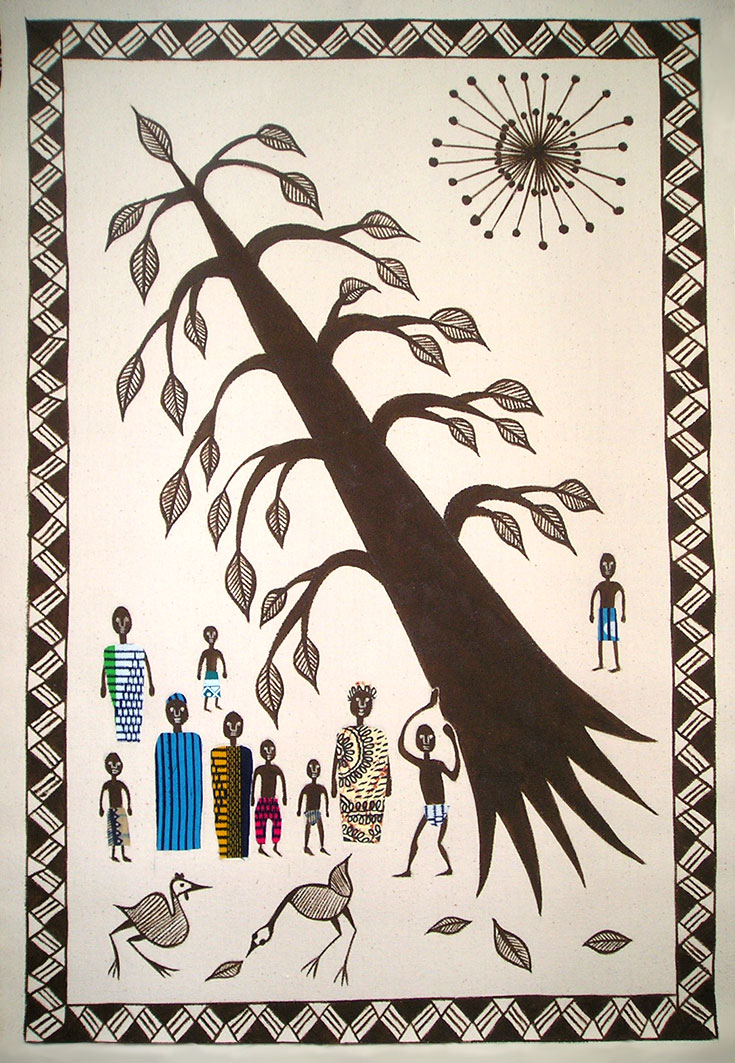
From Sundiata: An Epic of Old Mail by D.T. Niane:
Other peoples use writing to record the past, but this invention has killed the faculty of memory among them ... with them everybody thinks he knows, whereas learning should be a secret.Author's note: "According to the griots [storytellers] the Whites have vulgarized knowledge. When a Whhite knows something everybody knows it" (41).
School, First Week
The Zambian school system is not unfamiliar with decorum and procedure, but, in fact, revels in them. It is not uncommon to see a teacher arrive at school in a suit and white wingtip shoes, while many of his pupils lack uniforms and often shoes at all. This is not necessarily a sign of equality but the professional expectations of the institution. Despite lack of resources, lesson plans are strictly laid out and carefully drafted; teachers will spend their morning locating the necessary chalk and rulers to ensure their blackboards are tidy, structured, and pleasing to the eye. This infatuation with order is mimicked in the pupils' books, like echoes, and a blackboard's worth of information is copied verbatim, complete with titles and illustrations, so that the pupil can gain and retain information without having to read it, lest understand it. This is the system I operate in, seek to reform (the Ministry of Education describes my role as demonstrating and promoting learner-centered teaching), but at first I must understand it and integrate into it. So far this has meant waking up before roosters are able to disturb me, and bicycling through the dewy brush in a professional work appearance I never adopted in the States, taking copius notes, despite there being a secretary, of all meetings, and attend all of them I can; reading Ministry of Education's publications, despite much of them being dry as they are rigorous and some being printed in Comic Sans; filling out, as systematically as the morning will allow, observation forms while sitting in desks at the back of classes (or often, in a lone chair which makes me feel more the object than observer, especially when fifty first grade eyes are trained on me). This is not the image the mention of Peace Corps suggests (the intrepid American planting lima beans or digging latrines, son of the Kennedyesque era, which was before the institution dropped out of the public light); this does not bother me, nor does the title of Volunteer keep me from working, for in fact there is much to do. Attendance, particularly of girls and especially during agriculturally significant months, is low. Even when pupils pass entrance exams to the upper tiers of schooling, a limited amount of seats, particularly in high schools, means that those who have earned a place are not guaranteed it, and even if they gain entrance, their families may not be able to afford the fees. Although HIV/AIDS is on the curriculum, the official numbers of infected in Zambia only recently fell; teachers in particular, due to variety of factors, contract it more than average. These issues are not unknown to Zambians and the Ministry of Education; however, lack of resources, infrastructure, staff, and simply money keep many of the Ministry's well-intentioned and often robust policies from reaching full, or adequate, fruition. But I have few answers, and in fact have not discovered many of the questions. Instead I am working, week by week, at a Zambian Basic School (Grades 1-7 plus 8 and 9), listening to meetings bookended by opening and closing prayers, blanketed by systematic agendas; I am moving desks, some of them falling apart on setting them down, to fit an excessive amount of pupils in less classrooms with even fewer teachers; I am treating, as best I can, nosebleeds which leave in their wake a trail of crimson spots; in some cases, I am just showing up to see what I can do, or what I can see. We'll leave systematic policies and overarching solutions for another day.
Note:
About being a hero: Please don't let these rants be mistaken for a narrative, and its author a hero. I'm not particularly adventurous, as a child I would stand with a bed sheet as a cape at the end of the couch and not jump. I find comfort in the status quo while pretending not to. I am an iconoclast only on paper. If you see a picture of me with dark skinned African children, please know I am in their continent and these are probably my neighbors or students and that I am in no way saving them, giving them shoes, medicine, or adopting them. I am not Matt Damon. They are not the same children you saw on infomercials, they are just kids, full of energy and irreverent, fun on some days and annoying on others. Please don't see a picture of them as an invitation to send money, clothes, or pencils, even if they lack these: they need opportunities, not stuff. Opportunities that are not scattered, but flowing and even rampant. But don't let anyone, especially me, talk for them or put them on a billboard. Ask them for yourself. This sermon is brought to you by your American tax dollars.
Note:
About being a hero: Please don't let these rants be mistaken for a narrative, and its author a hero. I'm not particularly adventurous, as a child I would stand with a bed sheet as a cape at the end of the couch and not jump. I find comfort in the status quo while pretending not to. I am an iconoclast only on paper. If you see a picture of me with dark skinned African children, please know I am in their continent and these are probably my neighbors or students and that I am in no way saving them, giving them shoes, medicine, or adopting them. I am not Matt Damon. They are not the same children you saw on infomercials, they are just kids, full of energy and irreverent, fun on some days and annoying on others. Please don't see a picture of them as an invitation to send money, clothes, or pencils, even if they lack these: they need opportunities, not stuff. Opportunities that are not scattered, but flowing and even rampant. But don't let anyone, especially me, talk for them or put them on a billboard. Ask them for yourself. This sermon is brought to you by your American tax dollars.
June 25, 2011
Nshima
To theorize food is to study culture, in particular the path which arrives at the mouth and continues into the stomach, but begins elsewhere, in the intersection of agriculture, politics, geography, and the cultural tradition. To know Zambia one must know Nshima: it is as well received here as it is difficult to explain to outsiders. It is a type of porridge, thick enough to be taken by the right hand while hot, kneaded, accompanied by various relishes, and enjoyed. It is eaten by everyone and with every type of food (which, next to nshima, are termed relishes, because they are and will always be secondary). It is said a meal without nshima is not a meal at all. It is also said in times of hunger, at least there is nshima. It is made from dried and pounded grains combined with water just about to boil, and stirred. And stirred. When the mixture is too thick to be stirred, add more grain, and continue stirring. It is spooned out in lumps, so Zambian men can boast about how many of them they can eat. It is also found in communal pots, because it is particularly African not to separate, thus bestow individual ownership, to food.
To know the ingredients of nshima is to understand history. Most nshima is made from maize because this is the staple crop brought and introduced by the British and popularized under their management of the country. After deterritorialization (Zambia, unlike its southern neighbor, was never a British colony), maize remained in the forefront, eclipsing traditional nshimas made from cassava, millet, and sorghum. To eat nshima at an expensive lodge or restaurant in Lusaka is to enjoy breakfast meal (a finely pounded grain powder opposed to its village equivalent, mealy-meal) and revel in its whiteness, tastelessness, and lack of nutritional content. Maize nshima, even in the village has less nutrition than its traditional counterparts, so the distended stomachs of rural children - what some have termed "nshima bellies" - are not due to eating daily amounts of the substance, but a deficiency of nutrition contained within. White nshima, ironically a remnant of white territorialism, is sastisfying to the hunger as it is ultimately less than satisfying to one's health. Despite this, it remains popular throughout the country.
As mentioned before, nshima is accompanied by every locally available food, but there are some specialities. As a farmer in Chongwe related, Zambians eat not only vegetables, but the leafy extensions of them: they eat pumpkins and sweet potatoes, but also the leaves. Pumpkin leaves (chiwawa) are prepared by removing miniscule thorns and cooked with pounded peanuts (ground nuts) to make ifisashi (in fact, pounded ground nuts added to any vegetable is termed ifisashi). Note that with chiwawa, blossums and stems are cut and consumed along with the leaves. Sweet potato leaves (kalembula) are a darker leafy type, and taste of a tarter spinach when cooked. As saladi (cooking oil, usually sunflower oil) and salt are symbols of wealth as they are not locally prepared, and require a trip, often, to the closest town or tuck shop. So they are extensively used in the cuisine of those who can afford them, without regard to health concerns. Like nshima, they are Zambian essentials.
To know the ingredients of nshima is to understand history. Most nshima is made from maize because this is the staple crop brought and introduced by the British and popularized under their management of the country. After deterritorialization (Zambia, unlike its southern neighbor, was never a British colony), maize remained in the forefront, eclipsing traditional nshimas made from cassava, millet, and sorghum. To eat nshima at an expensive lodge or restaurant in Lusaka is to enjoy breakfast meal (a finely pounded grain powder opposed to its village equivalent, mealy-meal) and revel in its whiteness, tastelessness, and lack of nutritional content. Maize nshima, even in the village has less nutrition than its traditional counterparts, so the distended stomachs of rural children - what some have termed "nshima bellies" - are not due to eating daily amounts of the substance, but a deficiency of nutrition contained within. White nshima, ironically a remnant of white territorialism, is sastisfying to the hunger as it is ultimately less than satisfying to one's health. Despite this, it remains popular throughout the country.
As mentioned before, nshima is accompanied by every locally available food, but there are some specialities. As a farmer in Chongwe related, Zambians eat not only vegetables, but the leafy extensions of them: they eat pumpkins and sweet potatoes, but also the leaves. Pumpkin leaves (chiwawa) are prepared by removing miniscule thorns and cooked with pounded peanuts (ground nuts) to make ifisashi (in fact, pounded ground nuts added to any vegetable is termed ifisashi). Note that with chiwawa, blossums and stems are cut and consumed along with the leaves. Sweet potato leaves (kalembula) are a darker leafy type, and taste of a tarter spinach when cooked. As saladi (cooking oil, usually sunflower oil) and salt are symbols of wealth as they are not locally prepared, and require a trip, often, to the closest town or tuck shop. So they are extensively used in the cuisine of those who can afford them, without regard to health concerns. Like nshima, they are Zambian essentials.
Subscribe to:
Posts (Atom)