Showing posts with label Zambia. Show all posts
Showing posts with label Zambia. Show all posts
June 9, 2012

May 20, 2012
The Postcolonial
"The empire gave its colonies real, tangible benefits. Wherever the British ruled, they erected a light, relatively inexpensive form of government that was not corrupt, was stable, and was favourable to outside investors." Nick Llyod, defending the legacy of British colonialism
"What saves us is efficiency - the devotion to efficiency." Joseph Conrad, Heart of Darkness

The liberation has past. Independence still reigns but the moment of transition, and of struggle, age into the history books. Banners of protest have long been stored away, and anthems, fresh and vibrant as they were introduced, revert to droll phrases echoed by schoolchildren stationed around a flagpole in the dull morning light. The colony is no more, the commonwealth has dissipated, but what of the young nation state? What legacy has it inherited, and like any inheritor, what will it do with the spoils it has received?
March 3, 2012
Boys' Day (Ifishimu)
We are the original badasses.
This is the ending thought to today, boys' day. I began the morning with porridge as my host father yolked the cattle and brought them to the field. I continued work on a garden fence, an only partially haphazard combine of logs, sticks, straw, twine, and nails. I am the original construction worker. Steven helps me, holding up sticks as I tie them together. I am able to set a few poles before my palms are demolished by the Iron Age tool I borrowed, its hilt constructed from coarse wood.
Steven, on his own, starts peeling and slicing sweet potatoes and "Irish" potatoes. Before I know it, he starts making french fries, submerging the pieces in hot oil. We eat them, a respite from work.
More boys come, another Steven as well. As they play, I wander around with the hoe, looking for ideas. A tree is teeming with caterpillars. Black, furry, and yellow spotted with coarse white spines. I confirm with the boys that these are edible, and I ask them to show me how to cook them. Here is their recipe:
- Pluck the caterpillars (ifishimu) from tree branches. Climb the tree if necessary.
- Squeeze ingested plant juices from them. Discard.
- Boil the limp masses until the water is finished.
- Fry with oil. Add desired species, and serve with appropriate relishes.
We make a movie about this (see above). We are the original lords of the flies. I invent work to do so I can have some respite.
This was boys' day.
December 2, 2011
Amasuku, Bush Fruit
This marks the last post to this blog this year. In a few days I will be on a plane, heading to a vacation in Portugal, and will return in the new year. It's been a strange and interesting year, although it's seemed both longer and shorter than that, as if I stepped into a time vortex (and when I have to calculate time differences in order to make world-spanning phone calls, I feel as if I am). I want to thank all of my readers, family and friends who have made their voices louder so I can hear them, as far away as I am.
My last video for the year, it's about bush fruit. The kids, Bwalya, Lazslo, and Steven, are becoming emerging actors, and it's difficult to keep them out of the periphery of the camera lens. Look forward to more from them.
Merry old year and happy new one.
November 6, 2011
Another brief update
Welcome, November. The year has progressed exceptionally fast, and I have found myself in the midst of a variety of projects. As much as this blog has become a gallery of journal entries, a behind the scenes and in between the lines of the pleasures and vulgarities of Peace Corps service, this is more of an update of what takes place on the main stage, what occupies my day. So more lucidity, less metaphor.
November 5, 2011
The Park
 |
| Posing with animals I'm sure at one point I've eaten |
We are at Kasanka Park, a small national reserve noted for being the destination for a massive bat migration from the Democratic Republic of Congo. Fruit bats arriving to feast on mangos and anything else sweet hanging from trees. At dusk they awake and swarm, a tornado of flying rats, fit for any comic book hero. We made the bat signal out of wood and set it aflame, a tribute to the migration and our pop culture upbringing.
I shot a video and this is it:
October 15, 2011
Kids
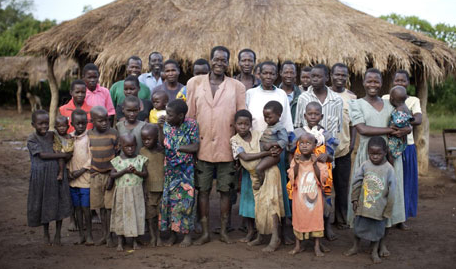
A popular question I get is: "How many are you?"
This is not directed nationally, as in how many musungus? But it is restrict to one's immediate family: I have two siblings, and together we are three, is my answer. I usually return the question, as I am learning to be less introverted. Often the answer is "We are just nine." Zambians have big families, even bigger as it is common to absorb orphans and relatives. But why the high birth rate?
China in Africa
This is a big discussion in Sub-Saharan Africa, particularly in Zambia: what's more preferable, Western nations which extend aid in the form of social programs and conditional loans, or China, which invests in business without the typical humanitarian strings attached. One is criticized as being economic parenting which is leading Africa to be depending on foreign aid; this is a view held by the Zambian economist Dambisa Moyo, author of Dead Aid. The criticism of the other is that China is exploiting Africa, a neo-colonist. This exchange between Asia and Africa is intended to benefit both, one with mined and farmed resources, the other with employment and infrastructure development. The railroad line, the Tanzana, near my house is Chinese built; Atlantic Monthly has an article on it. But Chinese business in Zambia is not without its disadvantages.
September 27, 2011
Charcoal
I want to write about charcoal. Little sooty pieces of magic. This is my second time writing of them, here's the first:
Today I met with Luke. I told him his name reminded me of Star Wars but he didn't get the reference. He saw my bicycling to my school, twice, and decided to meet me at my home, to see this white man in the middle of the African landscape. Luke is a charcoal dealer, he works on pieces of land converting the forest into dark pieces of energy and drives them, bundled, to Lusaka. He invited me to see the process and offered me a bag of charcoal, as I was beginning to question the nature of deforestation and burning fresh logs in my cooking shelter, splayed to resemble an asterisks, with bricks situated to hold up cooking pots.
Whether I am doing the forest justice, romantically reducing my distance to nature, or saving myself the inconvenience of locating a dealer with charcoal and carrying the load on my bicycle, I do not know. But I do know, and am discovering, that if you reduce daily life to its essentials - water, food, energy, cohabitation - you find both a phenomenon and a story.
September 25, 2011
Schedule
So how do I spend my day? This is a question no one has asked me that I will attempt to answer so that no one can read it. So I offer, on a whim, my daily schedule. Although my life looks good as a poster (or maybe a t-shirt), it is actually fairly routine, often droll, and replete with empty space. I don't often measure time with a clock, I have instead adopted the culture of reading the sun, and right now it is cresting the hills, soon to leave to shower its more favored side of the globe, only to return grudgingly and lazy in the morning. Thus I will not use conventional time references to describe my day.
September 24, 2011
Elections
Sunday.
Elections are on Tuesday. As of now the town, and parts of the village easily accessible are postered with blue, the ruling party, MMD (Movement for MultiParty Democracy), and green, the major opposition, PF (Patriotic Front). Politics are on the wall, in the air, and passing us by in vehicles with mounted loudspeakers.
First of all, let me explain why I can't talk about politics. Peace Corps, as a collaborator with the host national government of Zambia, and as an extension of the U.S. State Department, has as one of its conditions for existence a policy of non-participation in politics. We are diplomats with none of the privileges but all of the responsibilities. The Presidential election of Zambia, however, is to present not to be spoken on, as the campaigns have monopolized much of the periphery of my daily life. This picture I will paint will be as neutrally drawn as possible, it will be a pleasant landscape rather than a political call to arms, a Goya.
Elections are on Tuesday. As of now the town, and parts of the village easily accessible are postered with blue, the ruling party, MMD (Movement for MultiParty Democracy), and green, the major opposition, PF (Patriotic Front). Politics are on the wall, in the air, and passing us by in vehicles with mounted loudspeakers.
First of all, let me explain why I can't talk about politics. Peace Corps, as a collaborator with the host national government of Zambia, and as an extension of the U.S. State Department, has as one of its conditions for existence a policy of non-participation in politics. We are diplomats with none of the privileges but all of the responsibilities. The Presidential election of Zambia, however, is to present not to be spoken on, as the campaigns have monopolized much of the periphery of my daily life. This picture I will paint will be as neutrally drawn as possible, it will be a pleasant landscape rather than a political call to arms, a Goya.
August 27, 2011

July 31, 2011
Work
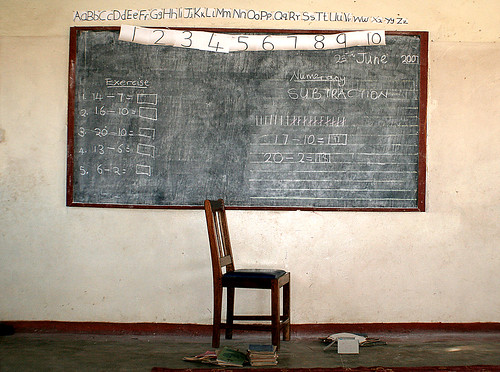
A large part of my time here has been creating a home life, getting to know my community and host family, learn the language and local dialect, and adapting to the culture. But I have also been working. I apologize for this entry not being as exotic or interesting as others, but it describes what I do with most of my time, and the reason I'm here in the first place, why these two countries decided to unite to construct an imaginary pipeline funneling recently graduated left wingers across the globe to live in huts, unsuccessfully start fires, and fumble with shortwave dials to pick up the slightest taste of home.
July 29, 2011
Community, Entered
"Each nation has many customs and practices which are not only unknown to another nation but barbarous and a cause of wonder." - Montaigne (in this context, he is referring to the differences in German and French house-warming stoves. If he only were to come to Africa.)
I have been living in the village of Chimupati, in Serenje District, in the middle of Zambia, in the center of Sub-Saharan Africa, for three months. I am finished with Community Entry, an artificial period of 90 days to orient myself to my community and them to me. From everyone's vantage point the world orbits them; in my case everything is moving faster around me, the train speeds by nearby and traffic follows a swift parallel path, while I spend the entire afternoon sitting on my porch.Here's a few notes, observations, and rants from my time here so far.
 |
| Serenje Boma, Zambia |
June 29, 2011
How to light a brasier
In Zambia, the kitchen is outside. Usually I burn wood in my insaka, or cooking shelter, the rotund building in the back of the video. But if I were to burn charcoal, the essential fuel of Zambia, this is how it is done. Steven is demonstrating how to light and sustain a fire, Bwalya is adding the teapot, and the rest of the kids are enjoying tea and candolo, sweet potatos, on my porch.
June 26, 2011
A portrait, briefly, of the school
As much as any description is layered, to degrees of thickness, with one's perceptions and values, I offer this portrait of the Zambian school, colored by the paints of my own thoughts and preconceptions.
The walls are often bare; the blackboard more often than not is painted in the front of the class, with black drips permanently splashed on the space between the board and the floor, as if the wall is melting in the heat of the dry season. The desks, normally arranged to face the front, are divided into groups to adhere to standards of a new curriculum development by an NGO. In fact, the school building itself, too nice in comparison to others, is the product of funding from JICA, a Japanese Peace Corps-esque aid organization. Posters sourced from Scandinavian NGOs and textbooks sponsored by USAID are constant reminders of the interconnectedness, what others would term dependence, of the developing African public school system. I am the only human sign of this foreign aid, other reforms have been already carried out or dropped from above: their authors having spent a few moments on the ground before returning to their countries, or sending funds and paperwork from abroad, satellite technicians of development.
The chalk powdered footprints of pupils lead outside, where they disappear where the concrete gives way quickly to dirt. The campus of the school and its gardens are neat, and pupils can be seen sweeping with bundles of branches and slashing grass with moderately sharpened curved metal rods. The classroom block which stands out from the others was one of the original buildings left after the new blocks were completed two years ago. Its ceiling beams are logs, rather than metal, the doorways are not encumbered by doors. Its middle classroom has holes in the floor large enough to swallow pencils and notebooks; the only room with a door, but no lock, is an office, also unused. The classes which are used have glassless windows which frame the bustle of women and children fetching watcher from a nearby bore hole. The walls are scrawled with incorrectly spelled messages in English advocating the smoking of weed and mourning the loss of dead friends and former lovers. The desks are a physical phenomenon in themselves. Often missing essential components such as nuts and bolts to hold them together, they can be precarious to sit on, and fall apart when moved. When functioning, they often hold more than their shape would allow; in fact, the presence of a visitor such as myself in an already overfull classroom sends ripples which moves students to four or five per desk, adolescent legs splayed as shoulders tightly touch. The edges of the desks, particle board with a slight bevel, wear significant signs of wear as they are moved from classrooms by the students themselves, shifting around to accommodate for fluctuating attendance.
The Head Teacher's office, immaculate, with piles of reports and letters stamped into officiality with the proper Ministry of Education stamps and signatures. And endless progression of parents, pupils, and community members come through, requesting transfers to and from other schools, bringing school purchased brooms and produce, and getting documentation of school fees paid for by NGOs. The library, so-called, is a locked cabinet with books cared for since their deployment, since it is not known when more will arrive.
The trees in front of the school are tall, some of them fir trees despite the climate, and I search for a metaphor to relate them to. If the Bemba proverb is true, and young trees make the forest, what happens if they aren't taken care of, or are overrun by weeds?
The pupils, with their pencils as nubs so small they look as if they are writing with nothing. A single razor blade, bent in half, is passed around the children and they slice slowly, in violation of nearly every American safety principle, in order to have them just sharp enough to write. They wet the graphite with their tongues and continue writing. A plastic bag plays the role of a pupil's backpack, and an empty liquor packet his or her pencil case.
And I will end here, and continue later.
The walls are often bare; the blackboard more often than not is painted in the front of the class, with black drips permanently splashed on the space between the board and the floor, as if the wall is melting in the heat of the dry season. The desks, normally arranged to face the front, are divided into groups to adhere to standards of a new curriculum development by an NGO. In fact, the school building itself, too nice in comparison to others, is the product of funding from JICA, a Japanese Peace Corps-esque aid organization. Posters sourced from Scandinavian NGOs and textbooks sponsored by USAID are constant reminders of the interconnectedness, what others would term dependence, of the developing African public school system. I am the only human sign of this foreign aid, other reforms have been already carried out or dropped from above: their authors having spent a few moments on the ground before returning to their countries, or sending funds and paperwork from abroad, satellite technicians of development.
The chalk powdered footprints of pupils lead outside, where they disappear where the concrete gives way quickly to dirt. The campus of the school and its gardens are neat, and pupils can be seen sweeping with bundles of branches and slashing grass with moderately sharpened curved metal rods. The classroom block which stands out from the others was one of the original buildings left after the new blocks were completed two years ago. Its ceiling beams are logs, rather than metal, the doorways are not encumbered by doors. Its middle classroom has holes in the floor large enough to swallow pencils and notebooks; the only room with a door, but no lock, is an office, also unused. The classes which are used have glassless windows which frame the bustle of women and children fetching watcher from a nearby bore hole. The walls are scrawled with incorrectly spelled messages in English advocating the smoking of weed and mourning the loss of dead friends and former lovers. The desks are a physical phenomenon in themselves. Often missing essential components such as nuts and bolts to hold them together, they can be precarious to sit on, and fall apart when moved. When functioning, they often hold more than their shape would allow; in fact, the presence of a visitor such as myself in an already overfull classroom sends ripples which moves students to four or five per desk, adolescent legs splayed as shoulders tightly touch. The edges of the desks, particle board with a slight bevel, wear significant signs of wear as they are moved from classrooms by the students themselves, shifting around to accommodate for fluctuating attendance.
The Head Teacher's office, immaculate, with piles of reports and letters stamped into officiality with the proper Ministry of Education stamps and signatures. And endless progression of parents, pupils, and community members come through, requesting transfers to and from other schools, bringing school purchased brooms and produce, and getting documentation of school fees paid for by NGOs. The library, so-called, is a locked cabinet with books cared for since their deployment, since it is not known when more will arrive.
The trees in front of the school are tall, some of them fir trees despite the climate, and I search for a metaphor to relate them to. If the Bemba proverb is true, and young trees make the forest, what happens if they aren't taken care of, or are overrun by weeds?
The pupils, with their pencils as nubs so small they look as if they are writing with nothing. A single razor blade, bent in half, is passed around the children and they slice slowly, in violation of nearly every American safety principle, in order to have them just sharp enough to write. They wet the graphite with their tongues and continue writing. A plastic bag plays the role of a pupil's backpack, and an empty liquor packet his or her pencil case.
And I will end here, and continue later.
Subscribe to:
Posts (Atom)