Showing posts with label education. Show all posts

June 27, 2014

New Paper: Green Machines and Constructionism


This week, a paper I wrote about the One Laptop Per Child project and recent studies of its deployments in Sub-Saharan Africa was published by InterActions, the UCLA Journal of Education and Information Studies. Here's the abstract:

This article is an analysis and literature review of the One Laptop Per Child (OLPC) program within the education sector, particularly the deployment of X-O laptops in the continent of Africa. While the project was created to address a specific issue - the digital divide - and undoubtedly had a significant impact in the field of technology, it has specific limitations: it reproduces a Western ideology of individualistic technology use and relies on a strict framework which fails to take local needs into consideration. Moreover, research on technology use in education, beyond X-O laptops, has focused mainly on developed countries. The article concludes that technology is not the panacea for education as envisioned by OLPC; moreover, its rigid mission goals and lack of independent studies ultimately hinder its aim of reducing the digital divide.

You can read the entire paper online here.

For more about how laptops are actually used in developing countries, the New York Times has an excellent video that documents a Peruvian village's four-year attempt to obtain electricity and Internet access.

[Photo by One Laptop Per Child / CC BY]

May 19, 2014

Teaching for the Test, Part II: The Inequality Industry

This is the second part of a series about Standardized Testing in the United States. The first part looked at the history of the SAT, and its origins in Army intelligence testing and scientific eugenics.

Source: College Board / New York Times

In between writing this series, the College Board announced a major overhaul of the SAT, in light of criticisms that the test measured knowledge of obscure and arcane vocabulary, gave high scores to inconhesive essays that used such vocabulary, and functioned more as a predictor of parents' income than intelligence. The New York Times has an in-depth report about the redesign; NPR has a story about how students that enroll in test-optional colleges (where the SAT or ACT is optional for admission) perform as well as students who take the tests - and that high school grades are often a better predictor of college success than performance on standardized exams.

In particular, the College Board will be collaborating with Khan Academy to provide test preparation for the new SAT, online and for free, as a direct response to the inequality of test preparation. I have some experience with the test prep industry as a teacher and tutor, and I eagerly look forward to the demise of these often deceptive and predatory businesses. Here's my story...

February 5, 2014

Surveillance and Education


It's undeniable that the NSA files leaked by Edward Snowden had a profound impact on issues of privacy, surveillance, and espionage. It revealed not only that the NSA and the private contractor GCHQ were working with technology and phone companies to secretly obtain data and records from customers and foil encryption, but also were conducting surveillance within online games and using Angry Birds as an example of a "leaky" and exploitable mobile application.

In light of these leaks, the public was able to discuss a formerly unknown phenomena, which has a scope and scale previously unimaginable: that intelligence agencies had been able to expand their powers, since 9/11, to collect unprecedented amounts of data on U.S. citizens, foreign leaders, and residents of other countries. To find a needle in the haystack - present or potential terrorists - the NSA and its partners had mapped out the size and quality of every strand of hay, and set up procedures to ensure their knowledge of future haystacks - the NSA's effort to undermine online encryption.

Virginia Eubanks, writing in the American Prospect, deflates the astonishment about Snowden's leaks: according to her, the poor and working class had already been subjected to surveillance and digital monitoring, including the tracking of welfare benefits by way of Electronic Benefit Transfer cards (high-tech), stop-and-frisk in New York City (low-tech), and local law enforcement adopting surveillance and military tactics on a smaller scale.

Thus, it's no surprise surveillance and monitoring is an increasingly present part of education, affecting the daily life of students, notably the children of poor and working-class parents, and structuring how administrators and policymakers think about education.


January 28, 2014

Teaching for the Test, Part I: Eugenics, Morons, and Mass Intelligence Testing

As a non-credentialed teacher, I encountered a pretty competitive job market after returning to the United States. Not only was it difficult to find a position in education, it was hard to find one anywhere. After countless resumes were sent and cover letters drafted, a combination of desperation and boredom led me to discover a vast and profitable shadow economy: standardized test preparation.

I never took the SAT or ACT, because I had an unusual alternative schooling. However, I did take the GRE in order to apply for graduate school. Since I was used to being overdeveloped in some areas and underdeveloped in others, I decided to study for the exam. Resources were easy to find, and my only purchase was a book from a major company whose sole purpose is providing preparation material for standardized tests.

After a few weeks, approaching the test turned into a game. I was roleplaying, and I upgraded my states by memorizing arcane and useless words, figuring out shortcuts to solving multiple choice math problems, and drilling on essay prompts. I didn't care about the test reflecting my natural intelligence or learned abilities from college. My score would represent the amount of time and effort I committed to cracking the test. I wanted a high score.

November 6, 2011

Another brief update

Welcome, November. The year has progressed exceptionally fast, and I have found myself in the midst of a variety of projects. As much as this blog has become a gallery of journal entries, a behind the scenes and in between the lines of the pleasures and vulgarities of Peace Corps service, this is more of an update of what takes place on the main stage, what occupies my day. So more lucidity, less metaphor.

September 25, 2011

The Universal


The Universal was a buckler, a disinfectant, a religion, a hope, an act of supreme poetry. The Universal created order. In those days, the blue-eyed Gaul with hair as yellow as wheat was everyone's ancestor. In those days, Europeans were the founders of History. The world, once shrouded in darkness, began with them.
 - Patrick Chamoiseau, "School Days"

July 31, 2011

Work


A large part of my time here has been creating a home life, getting to know my community and host family, learn the language and local dialect, and adapting to the culture. But I have also been working. I apologize for this entry not being as exotic or interesting as others, but it describes what I do with most of my time, and the reason I'm here in the first place, why these two countries decided to unite to construct an imaginary pipeline funneling recently graduated left wingers across the globe to live in huts, unsuccessfully start fires, and fumble with shortwave dials to pick up the slightest taste of home.

June 26, 2011

A portrait, briefly, of the school

As much as any description is layered, to degrees of thickness, with one's perceptions and values, I offer this portrait of the Zambian school, colored by the paints of my own thoughts and preconceptions.

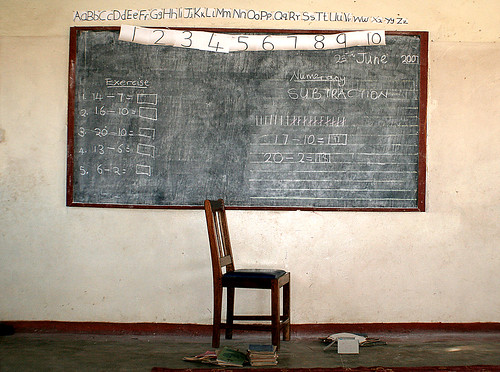
The walls are often bare; the blackboard more often than not is painted in the front of the class, with black drips permanently splashed on the space between the board and the floor, as if the wall is melting in the heat of the dry season. The desks, normally arranged to face the front, are divided into groups to adhere to standards of a new curriculum development by an NGO. In fact, the school building itself, too nice in comparison to others, is the product of funding from JICA, a Japanese Peace Corps-esque aid organization. Posters sourced from Scandinavian NGOs and textbooks sponsored by USAID are constant reminders of the interconnectedness, what others would term dependence, of the developing African public school system. I am the only human sign of this foreign aid, other reforms have been already carried out or dropped from above: their authors having spent a few moments on the ground before returning to their countries, or sending funds and paperwork from abroad, satellite technicians of development.

The chalk powdered footprints of pupils lead outside, where they disappear where the concrete gives way quickly to dirt. The campus of the school and its gardens are neat, and pupils can be seen sweeping with bundles of branches and slashing grass with moderately sharpened curved metal rods. The classroom block which stands out from the others was one of the original buildings left after the new blocks were completed two years ago. Its ceiling beams are logs, rather than metal, the doorways are not encumbered by doors. Its middle classroom has holes in the floor large enough to swallow pencils and notebooks; the only room with a door, but no lock, is an office, also unused. The classes which are used have glassless windows which frame the bustle of women and children fetching watcher from a nearby bore hole. The walls are scrawled with incorrectly spelled messages in English advocating the smoking of weed and mourning the loss of dead friends and former lovers. The desks are a physical phenomenon in themselves. Often missing essential components such as nuts and bolts to hold them together, they can be precarious to sit on, and fall apart when moved. When functioning, they often hold more than their shape would allow; in fact, the presence of a visitor such as myself in an already overfull classroom sends ripples which moves students to four or five per desk, adolescent legs splayed as shoulders tightly touch. The edges of the desks, particle board with a slight bevel, wear significant signs of wear as they are moved from classrooms by the students themselves, shifting around to accommodate for fluctuating attendance.

The Head Teacher's office, immaculate, with piles of reports and letters stamped into officiality with the proper Ministry of Education stamps and signatures. And endless progression of parents, pupils, and community members come through, requesting transfers to and from other schools, bringing school purchased brooms and produce, and getting documentation of school fees paid for by NGOs. The library, so-called, is a locked cabinet with books cared for since their deployment, since it is not known when more will arrive.

The trees in front of the school are tall, some of them fir trees despite the climate, and I search for a metaphor to relate them to. If the Bemba proverb is true, and young trees make the forest, what happens if they aren't taken care of, or are overrun by weeds?

The pupils, with their pencils as nubs so small they look as if they are writing with nothing. A single razor blade, bent in half, is passed around the children and they slice slowly, in violation of nearly every American safety principle, in order to have them just sharp enough to write. They wet the graphite with their tongues and continue writing. A plastic bag plays the role of a pupil's backpack, and an empty liquor packet his or her pencil case.

And I will end here, and continue later.